



Curved Metal Ceilings: A Decision Guide for Performance, Design, and Value

The modern interior is moving beyond flat planes and rigid grids toward spaces that breathe. A well-executed curved metal ceiling can guide movement, frame light, and create a memorable identity without overburdening the budget. For architects and developers who want both artistry and durability, a curved metal ceiling is more than a decorative choice — it is a strategic decision that shapes occupant experience, operational performance, and the financial life of the asset. This guide focuses on why and how curved metal systems deliver lasting value across large commercial projects and what to prioritize from concept through installation.
Foundation: Engineering and Manufacturing Precision
The Strength of Aluminum
Aluminum's high strength-to-weight ratio and excellent formability make it the preferred substrate for curved metal ceiling systems. It allows you to produce both sweeping, gentle arcs and tighter radii while keeping the structural load predictable.
That means shallower hangers, fewer bespoke supports, and less impact on slab or roof structure, which is a practical advantage when coordinating with MEP and structural frames. In aesthetic terms, aluminum enables long, continuous runs that maintain crisp sightlines and minimize visual clutter at junctions.
Factory Pre-fabrication vs. Field Adjustment
Factory-curved panels produced to a single CAD-derived radius deliver consistency: each panel slots into its designed position, preserving continuous sightlines. Field-bent panels or onsite trimming introduce cumulative error that shows up as uneven gaps, inconsistent joint reveal, and a loss of the intended visual rhythm.
Choosing factory-curved components reduces onsite labor, cuts the risk of costly rework, and shortens installation schedules — benefits that translate directly to lower overall project risk and more predictable costs for developers.
The Suspension Mechanism
Specialized carrier systems translate the design radius into adjustable hangers and clip locations so panels install smoothly along concave and convex paths. Think of the carrier as the ceiling’s spine: when it’s accurately surveyed and installed, the metal skin follows without warping.
This coordinated approach between manufacturing and the suspension system prevents the misalignments common to cheaper curved alternatives and simplifies onsite tolerance handling when the as-built conditions don’t perfectly match the base drawing.
Functional Superiority: Performance Beyond Aesthetics
Advanced Acoustic Management
Curved surfaces scatter sound, reducing sharp reflections that make large halls and atria feel noisy. Designers can pair perforated metal panels with acoustic backing to tune the environment: the ceiling preserves its metallic expression while absorbing critical mid- and high-frequency energy. Practically, this means you can guide speech and public-address intelligibility while keeping the lightness and sheen of metal, which is a combination that often outperforms equal-cost alternatives in real-world use.
Perforation Technology and Visual Control
Perforation patterns let you balance openness and containment. From afar, a perforated curve reads as a solid plane; up close, the pattern provides acoustic porosity and texture.
Designers use gradients in hole density to transition from intimate spaces to expansive volumes without changing materials. The visual continuity that results reduces cognitive load for occupants while solving acoustic and ventilation objectives.
Fire Safety and Environmental Durability
Aluminum behaves predictably under fire exposure and integrates with passive protection strategies commonly required in airports, hospitals, and other high-occupancy buildings. Its resistance to moisture and staining makes it preferable to gypsum and many wood products for semi-exposed or heavily cleaned interiors.
For projects with high humidity or frequent cleaning cycles, aluminum retains its finish and structural integrity with minimal intervention, which is a practical advantage for asset managers seeking low-maintenance solutions.
Airflow and Service Integration
Curved ceilings can effectively conceal complex HVAC runouts, diffusers, and lighting while maintaining performance. With early coordination, diffusers can sit behind perforated panels and linear lighting can be recessed into continuous profiles so the ceiling functions as both an aesthetic and operational plane. In short: a curved metal ceiling does more than look good and it becomes an integrated service surface.
Business Case: Analyzing ROI and Lifecycle Value
A distinctive ceiling is an asset-level decision, not merely an architectural flourish. Signature ceilings influence perception and can accelerate leasing, improve tenant retention, and command higher rents. When owners model lifecycle costs, curved metal systems frequently win: powder-coated or anodized aluminum resists wear, requires fewer re-coats, and allows discrete-panel repair rather than disruptive whole-surface renovation.
Time to occupancy matters. Modular, click-in curved systems typically install faster than site-built alternatives, which can shave weeks from fit-out timelines and unlock revenue earlier for owners. That speed, plus reduced maintenance and longer finish life, helps to offset higher initial material cost and contributes to a lower total cost of ownership across a 20–30 year span.
Sustainability and ESG considerations also favor metal: aluminum is highly recyclable and often contains post-consumer content, supporting circular-material strategies and contributing to LEED/BREEAM credits. The ability to replace only damaged panels reduces waste compared with full-area demolition and replacement strategies.
Sector-Specific Applications: Where Curves Make the Difference
Transportation hubs: Curved metal ceilings guide passenger flows visually while managing massive acoustic loads. A sweeping soffit from curb to check-in acts as both wayfinder and acoustic attenuator, surviving heavy cleaning regimes and operational wear.
Hospitality and retail: Ceilings create moments. A tailored curved canopy above a reception desk or a sculptural cove in a flagship store becomes brand-defining, coordinated with layered lighting to produce memorable arrivals.
Education and healthcare: Soft, organic lines humanize institutional interiors and reduce the visual stress of exposed mechanical systems. Replaceable panels enable non-disruptive maintenance in continuous operations environments, improving hygiene and reducing downtime.
From Concept to Installation: Overcoming Project Challenges
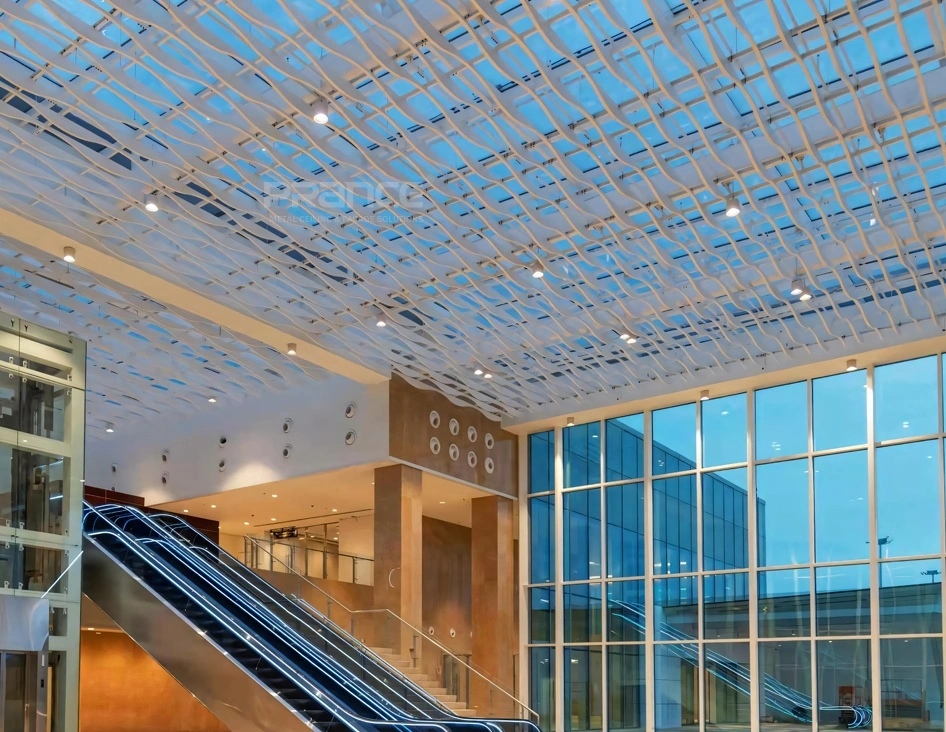
Large-scale curved ceiling projects demand more than standard supplier relationships; they require integrated services that reduce site risk. PRANCE is a good illustration of a one-stop solution model. They begin with precise Site Measurement using laser scanning and experienced field teams to capture true as-built geometry.
Next, Design Deepening converts conceptual intent into detailed shop drawings that specify true radii, hanger coordinates, cutting patterns, and service penetrations. Finally, Production takes over with factory-curing, finishing, and quality control against approved mock-ups.
The benefit is practical: fewer RFIs, far fewer onsite adjustments, and a higher probability that the installed ceiling matches the designer’s render. For developers, that means fewer delays and predictable commissioning. For architects and interior designers, it means preserving design intent and delivering the intended experiential impact without the headaches of piecemeal coordination.
Design Freedom: Materials, Finishes, and Visual Strategies
Curved metal ceilings provide a broad expressive palette. Finish selection alters perception: matte powders read calm and contemporary; anodized surfaces feel premium and tactile; heat-transferred wood-grain on metal gives the warmth of wood with the durability of metal. Perforation gradients and opacity modulation create directional emphasis and daylight filtering, allowing one material to carry multiple functional roles across a space.
Consider practical visual choices early: where are the primary sightlines, how will light skim the surface, and will the ceiling be in a high-touch location? High-gloss treatments dramatize curvature but show fingerprints; matte powders are forgiving and often preferable in hospitality or education.
Practicality: Maintenance, Access, and Durability
Service design. Panelized systems allow local access: individual panels lift from carriers for targeted mechanical servicing rather than requiring wide-area removal. That capability is vital in 24/7 facilities. For hygiene-critical environments, choose smooth finishes and sealed joints; for high-traffic retail, pick coatings resistant to abrasion and frequent cleaning. Confirm approved cleaning agents and abrasion thresholds with the finish supplier to safeguard long-term appearance.
Specification Checklist for Decision Making

Specifying a curved metal ceiling is less about choosing a product and more about defining intent with precision. Clear early inputs prevent redesign, site improvisation, and visual compromise later.
Geometry First
Provide the exact radius, arc length, and key control points for each ceiling zone. A true geometric definition ensures the curve you design is the curve that gets manufactured and installed.
Finish and Visual Mock-Up
Review coatings, perforation patterns, and surface texture under the project’s real lighting conditions. Curved surfaces interact with light differently from flat ones, and mock-ups help avoid unexpected glare, color shift, or pattern distortion.
Service Integration Planning
Coordinate lighting, sprinklers, speakers, diffusers, and sensors before fabrication. Pre-planned integration eliminates risky onsite cutting and preserves both structural integrity and visual continuity.
Capability of the Vendor
Prioritize manufacturers who provide CAD support, shop drawings, and onsite coordination. Technical backing at this stage is what keeps complex ceiling geometry buildable and predictable during installation.
Comparison Table: Scenario Guide
Scenario | Recommended System | Why it fits |
Airport arrival hall with high reverberation | Perforated, factory-curved aluminum with acoustic backing | Curves diffuse sound; perforations + lining control reverberation while preserving metal aesthetic |
Luxury hotel lobby seeking a premium feel | Anodized continuous aluminum soffit with integrated linear lighting | Anodize reads premium and endures high-touch; lighting sculpts the curve visually |
Retail flagship with frequent display changes | Click-in modular curved panels, powder-coated finish | Modular panels enable targeted changes; powder coat resists wear and matches brand palette |
Hospital corridor requiring frequent cleaning | Smooth, powder-coated concave panels with sealed joints | Smooth surfaces are easier to disinfect; sealed joints limit contaminants and simplify maintenance |
University atrium focused on speech clarity | Gradated perforation curve with acoustic infill | Visual gradient plus targeted absorption balances openness with speech privacy |
FAQ
Q1: Can a curved metal ceiling be used in humid or semi-exposed interiors?
Yes. Aluminum resists corrosion and, with proper powder-coating or anodizing, tolerates humid interiors better than gypsum or wood. For semi-exposed areas with salt or harsh cleaning, specify marine-grade finishes and a planned maintenance program to protect long-term appearance.
Q2: How do I access mechanical, electrical, and plumbing above a curved ceiling for maintenance?
Curved metal systems are typically panelized with removable access panels. Coordinate access locations with MEP early and confirm panel removal methods with the installer to avoid field cutting. This protects the finish and reduces downtime for routine service.
Q3: Is a curved metal ceiling suitable for retrofitting older buildings?
Absolutely. Their lightweight construction often allows hanging from an existing structure using supplementary hangers. Early site measurement and a mock-up confirm clearances, relationships to existing soffits, and interfacing with other trades, limiting unforeseen complexity.
Q4: How do curved ceilings perform with integrated lighting and sprinklers?
When coordinated in the shop drawing phase, curved ceilings conceal linear lighting and locate sprinkler heads without sacrificing compliance. Use fixtures and hardware specified for the curve and involve the fire engineer early so that penetrations and coverage maintain safety and aesthetics.
Q5: Will a curved metal ceiling limit future tenant fit-outs or design changes?
Not if modularity and access are specified. Click-in systems allow individual panel removal and reconfiguration, and service zones can be planned so future tenants can adapt spaces with minimal demolition. This preserves flexibility and reduces lifecycle disruption.
Conclusion: Future-Proofing Architectural Design
Curved metal ceilings merge expressive freedom with practical performance. They are a canvas for light, a tool for acoustic control, and a durable skin that ages gracefully. For developers, they deliver market differentiation and lower long-term maintenance risk. For architects, they expand what’s possible without compromising buildability. The true determinants of success are coordination and partner selection: precise measurement, thoughtful detailing, and a manufacturer capable of translating design intent into consistent, factory-finished panels.
If your project relies on the ceiling as a key architectural feature, involve technical specialists early. Aligning radius, finishes, and service integration at the design stage reduces construction risk, controls costs, and ensures the final curved metal ceiling delivers exactly what your concept promises. Contact a PRANCE expert to discuss your project.